Discord



'/%3e%3c/g%3e%3cdefs%3e%3clinearGradient%20id='paint0_linear_91_7909'%20x1='2.80579'%20y1='2.93848'%20x2='14.3838'%20y2='4.55824'%20gradientUnits='userSpaceOnUse'%3e%3cstop%20stop-color='%231198B9'/%3e%3cstop%20offset='0.0001'%20stop-color='%230F9DB8'/%3e%3cstop%20offset='1'%20stop-color='%232468C0'/%3e%3c/linearGradient%3e%3c/defs%3e%3c/svg%3e)
'/%3e%3c/g%3e%3cdefs%3e%3clinearGradient%20id='paint0_linear_91_7889'%20x1='4.20874'%20y1='4.40771'%20x2='21.5757'%20y2='6.83736'%20gradientUnits='userSpaceOnUse'%3e%3cstop%20stop-color='%231198B9'/%3e%3cstop%20offset='0.0001'%20stop-color='%230F9DB8'/%3e%3cstop%20offset='1'%20stop-color='%232468C0'/%3e%3c/linearGradient%3e%3c/defs%3e%3c/svg%3e)


















Amsterdam is the best-connected place in Europe to put a server, and it is not particularly close. AMS-IX moves more traffic than almost any exchange on the planet, the Netherlands has landing points for most of the transatlantic cable systems, and Dutch power and cooling economics mean the capacity keeps getting built. If your users are anywhere in Western Europe, an Amsterdam VPS is usually the shortest path to them.
The catch is that "Netherlands" in a hosting company's location dropdown means several different things. Some providers own Dutch facilities. Some rent a cabinet in Equinix AM5. Some resell another provider's Amsterdam region under their own brand. And a few still list a Dutch location they quietly stopped operating.
This ranks ten providers with genuine, verifiable Dutch infrastructure. We are CloudBlast, our Amsterdam region is our flagship, and we are first. There is also a section at the end naming the providers whose Dutch presence is not what it appears, which is the part most of these lists leave out.
How We Ranked These
Real Dutch infrastructure. The provider operates or directly contracts capacity in the Netherlands. Reselling someone else's Amsterdam region is a different product and we say so where it applies.
Network quality, not just location. Being in Amsterdam is worth little on a 200 Mbit port. Port speed, peering, and whether traffic is metered decide whether the location actually helps.
Price for a realistic box. Roughly 2 to 3 cores, 4 GB of RAM, 30 GB or more of NVMe.
Data residency. Whether you can guarantee data stays on Dutch soil, and who ultimately owns the company holding it. This matters more in 2026 than it did in 2023, particularly for anyone weighing EU sovereignty against US-owned providers with EU regions.
Hourly or monthly. Whether you can tear infrastructure down without paying for the month.
Quick Comparison
Entry pricing as of August 2026. "Dutch-owned" means the operating company is Netherlands-based, not just the data centre.
| Provider | Amsterdam presence | Entry price | Port and traffic | Dutch-owned |
|---|---|---|---|---|
| CloudBlast | Own region, flagship | €3.60/mo | 10 Gbps, unmetered | No |
| Leaseweb | Two Amsterdam facilities | €3.99/mo | 10 Gbps, NVMe | Yes |
| TransIP | Dutch facilities | €7.50/mo | 1 Gbps | Yes |
| DigitalOcean | AMS3 region | $6/mo | 1 TB egress included | No |
| UpCloud | NL-AMS1, by AMS-IX | from about €3/mo | Metered per plan | No |
| Vultr | Amsterdam region | from $2.50/mo | 0.5 TB and up | No |
| Scaleway | nl-ams-1 and nl-ams-2 | from about €0.01/h | Metered per type | No |
| Akamai (Linode) | Amsterdam region | $5/mo | 1 TB, then metered | No |
| Kamatera | Amsterdam + 5 EU DCs | from $4/mo | Metered | No |
| RackNerd | Equinix AM5 | about $11.29/year | 1.5 TB | No |
1. CloudBlast
Best for: unmetered 10 Gbps out of Amsterdam at a price that usually buys you a 200 Mbit port.
Entry plan: VMA11, 1 AMD EPYC core, 3 GB RAM, 20 GB NVMe, €3.60/mo or €0.0049/h.
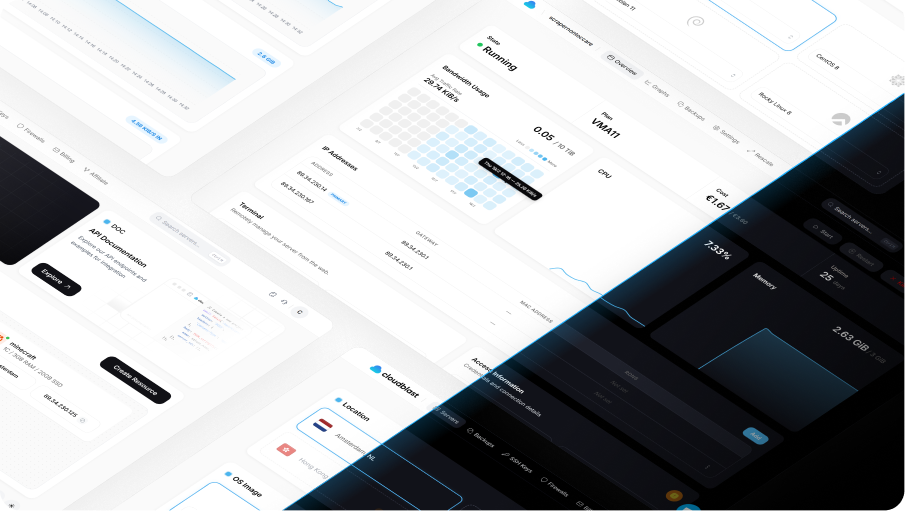
Amsterdam is our primary region and the one we designed the network around. Every instance gets a 10 Gbps port and traffic there is unmetered, with no fair-use asterisk and no per-GB meter waiting at the end of the month. That combination is the whole argument for hosting with us in the Netherlands: most providers at this price cap the port, meter the traffic, or both.
The hardware is the same across all eight plans, 3 GB to 64 GB of RAM on AMD EPYC with NVMe throughout, and there is no "high performance" tier you have to upgrade into to get decent silicon. DDoS mitigation sits in front of the entire network with up to 2.5 Tbps of scrubbing capacity, included rather than sold separately, which matters in Amsterdam specifically because it is a busy enough neighbourhood to attract attention.
Billing is hourly on every plan, so a staging environment or a build agent in Amsterdam costs what it uses. The control plane is a custom panel plus a public API and an MCP server. One-click app images cover the common self-hosting stack.
On data residency: the servers are physically in the Netherlands and your data stays there. We are not a Dutch company, so if your requirement is specifically Dutch corporate ownership rather than Dutch data location, Leaseweb and TransIP below are the honest answer.
What we like: unmetered 10 Gbps in Amsterdam, EPYC and NVMe on every tier, 2.5 Tbps DDoS protection included, hourly billing, no renewal increase.
What to watch: three regions worldwide, so this is not a global footprint play. Not a Dutch-owned company. No managed database or Kubernetes product.
2. Leaseweb
Best for: Dutch-owned infrastructure at genuine cloud prices, which is new as of this year.
Leaseweb is one of the Netherlands' largest hosting companies and has operated Dutch facilities for two decades, but its VPS product used to be an afterthought priced for enterprise. That changed in January 2026 with a new VPS tier from €3.99/mo running high-performance CPUs, local NVMe and 10 Gbps uplinks, out of two Amsterdam facilities.
The more interesting part for anyone automating is the tooling that shipped with it: an AWS-compatible REST API, Terraform modules and a CLI. An AWS-compatible API on a Dutch-owned provider is a genuinely useful combination if you are migrating off a hyperscaler for sovereignty reasons and do not want to rewrite your infrastructure code.
This is the strongest Dutch-owned option on the list and the one we would point at first if corporate ownership is part of your requirement.
What we like: Dutch-owned with two Amsterdam facilities, competitive pricing since January 2026, 10 Gbps and NVMe, AWS-compatible API plus Terraform, serious network engineering behind it.
What to watch: the cheap VPS tier is new, so there is less community track record than the older products. Support is tiered. The wider product catalogue is enterprise-shaped and can be hard to navigate.
3. TransIP
Best for: Dutch data that must stay under Dutch corporate control, with managed options.
TransIP is about as Dutch as hosting gets: Netherlands-based, Netherlands-owned, ISO 27001 certified, with data centres on Dutch soil. If your compliance requirement is written in terms of national sovereignty rather than EU-wide GDPR, this is the cleanest answer here.
The entry VPS is €7.50/mo for 1 vCPU, 2 GB RAM and 50 GB SSD. That is roughly double what comparable specs cost elsewhere on this list, and the network tops out at 1 Gbps rather than the 10 Gbps that performance-focused providers now offer as standard. You are paying a premium for the jurisdiction and the local support relationship.
Their managed packages are worth knowing about if you do not want to run system administration yourself, covering updates, monitoring and basic security.
What we like: genuinely Dutch-owned and Dutch-hosted, ISO 27001, managed options, Dutch-language support with local business hours.
What to watch: the most expensive price per core here for the specs. 1 Gbps network. Aimed at the Dutch domestic market, so some of the experience assumes you operate there.
4. DigitalOcean
Best for: an Amsterdam box with managed Postgres and object storage in the same region.
AMS3 is one of DigitalOcean's oldest and busiest regions, and it is well-run. Droplets start at $4/mo, the $6 tier gets 1 GB with 1 TB of outbound transfer, and the popular 2 vCPU / 4 GB configuration is $24/mo. Per-second billing arrived in January 2026 with a 60-second minimum.
What you are buying in Amsterdam specifically is the surrounding platform: managed databases, Spaces object storage and App Platform all available in the same region, so you can keep an entire stack inside Dutch borders without stitching providers together.
Note that AMS2, an older Amsterdam region, has been in wind-down for years. New deployments should use AMS3.
What we like: mature Amsterdam region, per-second billing, managed services in-region, pooled bandwidth, excellent docs.
What to watch: roughly 4x the price per core of the value providers here. Egress overage at $0.01/GiB. US-owned, which matters if sovereignty is the driver.
5. UpCloud
Best for: the best disk performance in Amsterdam, sitting directly on AMS-IX.
UpCloud's NL-AMS1 was deliberately sited right by the AMS-IX exchange, which is about as good as European network positioning gets. It is one of twelve UpCloud regions and one of the better-connected ones.
The reason to pick UpCloud over cheaper Amsterdam options is MaxIOPS, their storage backend, which benchmarks near the top of the field. For a database server in Amsterdam serving European users, the combination of AMS-IX proximity and fast disk is a coherent argument. Billing is hourly, pricing is quoted in euros, and small Developer plans start around €3/mo.
The company is Finnish, so this is EU-owned but not Dutch-owned.
What we like: located at AMS-IX, MaxIOPS storage performance, hourly billing, clean euro pricing, EU company.
What to watch: more expensive per core than the value end. Smaller managed-services catalogue. Finnish rather than Dutch ownership.
6. Vultr
Best for: an Amsterdam node as one of thirty-plus you might want.
Vultr's Amsterdam region behaves like the rest of its fleet: hourly billing capped at 672 hours a month, quick provisioning, and the same panel whether you are deploying in Amsterdam, Tokyo or São Paulo. If Amsterdam is one location in a distributed deployment rather than the only one, that consistency is the point.
Pick the tier carefully. Regular Performance from $2.50/mo is shared Intel with SATA SSDs. High Performance and High Frequency from around $6/mo are AMD EPYC or 3 GHz+ Xeon with NVMe, and that is the fair comparison against everything else here.
What we like: over thirty locations with Amsterdam among them, 672-hour monthly cap, bare metal and GPU in the same account.
What to watch: the Regular Performance tier makes the headline price misleading. Small bandwidth allowances with billed overage on cheap plans.
7. Scaleway
Best for: EU sovereignty with two Amsterdam availability zones and a real cloud API.
Scaleway opened AMS1 in 2016 to serve Benelux and Northern Europe, and has since added a second Amsterdam availability zone, nl-ams-2. Two AZs in one metro is something most providers on this list do not offer, and it makes Amsterdam a viable home for anything that needs zone-level redundancy without leaving the country.
Billing is per hour across the whole stack, including flexible IPs at €0.004/h and snapshots per GB per hour. That granularity is excellent for ephemeral work and genuinely difficult to forecast for steady-state work.
Scaleway is French-owned, so for EU sovereignty it qualifies and for Dutch sovereignty specifically it does not.
What we like: two Amsterdam availability zones, French and therefore EU ownership, strong API and Terraform provider, per-hour billing on everything.
What to watch: hard to forecast the bill. Stock in popular zones can be tight. Support is a paid tier.
8. Akamai Cloud (Linode)
Best for: a predictable Amsterdam box with Akamai's edge network behind it.
Linode added Amsterdam relatively late compared to the others here, but the region is solid and behaves like every other Linode region, which is the appeal. The $5 Nanode is still $5, the 2 GB plan is still $12, and the Akamai acquisition changed neither. Hourly billing with a monthly cap applies throughout.
The wider Akamai edge network is the differentiator if you are serving content from Amsterdam to the rest of Europe, since the origin and the CDN end up under one account.
What we like: stable pricing through the acquisition, hourly with a hard cap, pooled transfer, good CLI and API, edge network integration.
What to watch: shared CPU tiers are underpowered for the price. US-owned. Documentation has become harder to navigate post-rebrand.
9. Kamatera
Best for: oddly-shaped Amsterdam servers, and hourly billing that stops on power-off.
Kamatera runs Amsterdam alongside five other European data centres, with pricing from $4/mo and fully à la carte sizing. Rather than fixed plans you choose CPU, RAM and disk independently, which suits requirements that do not fit a standard tier, like a lot of RAM with almost no disk.
Its distinguishing feature across this whole category is that hourly compute charges stop when you power a server down, rather than requiring you to destroy it. For an Amsterdam machine you want to keep configured but only run occasionally, that is a real advantage.
What we like: à la carte resource sizing, compute billing stops on power-off, Amsterdam plus five other EU locations, hourly or monthly per server.
What to watch: performance varies noticeably between regions. Storage keeps billing while stopped. Dated control panel.
10. RackNerd
Best for: the cheapest Amsterdam box that exists, for workloads where that is the only criterion.
RackNerd's Amsterdam presence is in Equinix AM5, one of the better-connected facilities in the city, and they run VPS, dedicated servers and colocation out of it. Annual plans start around $11.29 a year for 1 GB of RAM, 1 vCPU, 21 GB of SSD and 1.5 TB of bandwidth, with promotional rates that lock in at renewal as long as service is continuous.
This is a different category from everything above. Annual prepay only, no meaningful API, minimal support. For a European monitoring node, a VPN endpoint, secondary DNS or an off-site backup target in Amsterdam, it is the right tool. For anything with revenue attached, it is not.
What we like: Equinix AM5 is a good building, locked renewal pricing, KVM, absurdly cheap.
What to watch: annual prepay, oversold nodes, minimal support, no automation story.
Providers Whose Dutch Presence Is Not What It Looks Like
This is the part worth checking before you trust a location dropdown.
FastComet dropped Amsterdam in April 2025. Its European locations are now Frankfurt, London and Milan. Older comparison articles still list it as a Netherlands option.
Time4VPS has never operated a Dutch facility despite appearing on Netherlands hosting lists. Its infrastructure is Lithuanian.
SiteGround markets a Netherlands location that is Eemshaven, roughly 180 km north of Amsterdam near the German border. That is genuinely in the Netherlands and genuinely not Amsterdam, and the peering picture is different.
Cloudways deploys to Amsterdam by provisioning on DigitalOcean underneath. You get an Amsterdam server, but you are buying a management layer over someone else's region, at a markup, and your data residency depends on their provider not yours.
Hetzner has no Dutch facility at all. It is the obvious name missing from this list, and the reason is simply that its European capacity is in Germany and Finland. Excellent provider, wrong country for this article.
None of that makes these bad hosts. It makes them bad answers to "I need a server in the Netherlands", which is a different question.
Why Amsterdam Specifically
AMS-IX. One of the largest internet exchanges in the world by traffic, with the practical effect that a well-peered Amsterdam host reaches most European networks in very few hops. Latency to London, Frankfurt, Paris and Brussels is typically in the single-digit to low-double-digit milliseconds.
Transatlantic cable landings. The Netherlands sits at the European end of several major cable systems, which is why Amsterdam is often the lowest-latency European location from the US East Coast.
Legal and regulatory. Dutch data protection sits inside GDPR with a regulator that is active and predictable. For EU-facing services it is a straightforward jurisdiction to operate in.
Power and capacity. Amsterdam has had its capacity constraints and municipal moratoriums, but the wider Randstad region kept building. There is real competition between facilities, and that shows up in what a rack costs and therefore what a VPS costs.
The practical upshot: if your users are in Western Europe, an Amsterdam VPS is close to the default correct answer. If your users are concentrated in a single country further out, host there instead. Every 1,000 km adds roughly 10 ms round trip, and a TLS handshake multiplies it.
Frequently Asked Questions
What is the cheapest cloud VPS in the Netherlands?
RackNerd is cheapest in absolute terms at around $11.29 a year out of Equinix AM5, but that is annual prepay with minimal support. For a usable production server, CloudBlast's VMA11 at €3.60/mo gives you an AMD EPYC core, 3 GB RAM, 20 GB NVMe and an unmetered 10 Gbps port in Amsterdam. Leaseweb's new €3.99/mo tier is the closest Dutch-owned equivalent.
Which Netherlands VPS providers are actually Dutch companies?
Leaseweb and TransIP are the Dutch-owned options on this list. Everyone else operates Dutch infrastructure while being headquartered elsewhere: CloudBlast, DigitalOcean, Vultr, Akamai and RackNerd are US-linked, UpCloud is Finnish, Scaleway is French. If your requirement is Dutch data location, any of them work. If it is Dutch corporate ownership, the list is two names long.
Does hosting in the Netherlands help with GDPR compliance?
It helps, but it is not sufficient on its own. Keeping personal data inside the EU removes the transfer question, and the Netherlands is a well-understood jurisdiction with an active regulator. GDPR compliance still depends on your lawful basis, your retention policy, your processor agreements and your security measures. The server location is one input.
How much latency should I expect from Amsterdam?
Roughly 5 to 15 ms to London, Frankfurt, Brussels and Paris. Around 20 to 30 ms to Madrid, Milan and the Nordics. Approximately 75 to 90 ms to the US East Coast, which is among the best in Europe thanks to the cable landings. Benchmark it yourself rather than trusting a table, since your transit path matters more than the straight-line distance.
Is Amsterdam better than Frankfurt or London for European hosting?
For pan-European reach, usually yes, because of AMS-IX peering density and the cable landings. Frankfurt is the better choice if your users are concentrated in Germany, Austria, Switzerland or Central and Eastern Europe, since DE-CIX serves that region more directly. London is better only if your users are predominantly UK-based, and post-Brexit it carries its own data transfer considerations.
Can I get unmetered bandwidth on a Netherlands VPS?
Yes, but read the port speed. Unmetered traffic on a 200 Mbit or 1 Gbps port is a very different product from unmetered on 10 Gbps. CloudBlast provides unmetered traffic on a 10 Gbps port in Amsterdam. Several providers advertising "unlimited" cap the port low enough that the cap never becomes the binding constraint.
The Verdict
CloudBlast for unmetered 10 Gbps out of Amsterdam on AMD EPYC and NVMe at €3.60/mo, with hourly billing and DDoS protection included. Leaseweb if you want Dutch corporate ownership at a comparable price, with an AWS-compatible API. TransIP if the compliance requirement is specifically Dutch and you want managed options. DigitalOcean if you need managed databases in-region. UpCloud if disk throughput is your bottleneck and AMS-IX proximity matters. RackNerd for the Amsterdam boxes that do not matter.
Before you commit, deploy the smallest plan and run iperf3 to a nearby endpoint plus fio on the disk. An hour of a €0.005/h instance costs half a cent, and a real measurement from Amsterdam beats any list, including this one.